“An
adventure is misery and discomfort, relived in the safety of reminiscence.”--Marco Polo
This past year, I knocked out a 50 Mile Run, Rim to Rim to Rim of the Grand Canyon, and Ironman Arizona once again. At one point, all of these things seemed impossible. But with them solidly in the rear view mirror, I feel like it's time to up the ante. Not to take anything away from the these accomplishments, but I'm ready to try things that seem really and seriously impossible--a 100 mile run and a Double Iron distance race (281.2 miles).
I think that race distances are like kids--you just want to have one more, until that last one is just too much. And I'm not there yet.
Yes, the lure of combining things that I really love--swimming, biking running--with something that I really hate--being awake for 20-30 continuous hours--is just too much for me to leave it alone. Plus, I'm going to be 49 this year, at the "bottom" of the 45-49 age group. Not that Kona qualification for the 50-54 age group was any slower--It just wasn't.
So I'm signed up for the Born to Run 100 miler in California, just 2 days after the big 4-9. Then in October, the Virginia Double Anvil. And just because that's what this year is all about, I will also be doing the Wilderman 140.6 offroad triathlon in between. And IMAZ again 6 weeks later, only without all those pesky expectations of being in prime condition to make a run at Kona.
I'll probably find a few more reasonable things to do. As always, Karen and I will have our annual Valentine's Day Outing, the Mt. Taylor Winter Quad in Grants, NM.
So, it looks like next year will also be full to overflowing with awesomeness. See you on the trail, on the bike path, or in the pool.

Wednesday, December 9, 2015

Friday, October 9, 2015
Atrial Bleeping Fibrillation, Part III: P-Waves From Heaven
On Monday night, I went for a quick, easy run while the kids were at Karate. I was definitely in atrial fibrillation when I started. So I started off with what appeared to be the "new normal," a heart rate limited slog at roughly 50 miler pace. But I just kept going, pushing a little harder from time to time to see how it felt. By the last hill, I felt pretty good, but didn't think anything of it, even afterwards.
But as I would discover later, my heart had snapped back into regular rhythm.
 With a quick study of the .gpx file from the run on Trainingpeaks, I think I can guess to within a minute when I converted back to Normal Sinus Rhythm by looking at how efficiently I run. The metric of "Efficiency Factor" (EF) is computed by dividing running speed (normalized for grade) in yards per minute by average heart rate. Note the overall EF of 1.43 in the first frame:
Frame 2 highlights a roughly 2 minute segment 12-13 minutes into the run, with EF of 1.28. This is typical of what I've seen during my week of Afib, and is far from the EF of 1.5-1.6 that I usually see. A 10-20% loss of high end cardiac output, and therefore efficiency, is what is expected for Afib. Not a literal killer, but certainly a killer of any chance of qualifying for the Ironman World Championships, which has been a perennial goal of mine for the last 3 years.

And in the final frame, the EF is suddenly back to normal values:
 Later that evening, I checked my pulse, expecting it to be irregularly irregular again. But it was surprisingly constant. I didn't want to believe it, but it remaines so five minutes later. And in the morning, I hooked myself up to a monitor at work:
P-waves! Glorious P-waves! And they've remained there since. With the exception of a couple of skipped beats that scared the holy hell out of me, they've remained.
The next morning, I felt as if someone had slipped me an (extra) quad espresso. I was walking on air, and my swim felt supercharged.
Unfortunately, speaking of espresso, I'm still going to pursue the prudent course and keep ratcheting down caffeine. I'm grieving. I love me some stimulating beverage. It's basically my only remaining vice.
The leading theory for how it happened to me remains the altitude tent, or at the very least, the simulated height to which I pushed it and how soon I did it (increasing 500-1,000 "feet"/week, sleeping nightly (and often poorly) at 10,000 "feet." This article (Thanks to Ted Rasoumoff) would suggest that pulmonary artery pressures go up substantially, even in asymptomatic residents of high altitude. Between this and three 20 hour weeks of training, plus work, plus family time and duties...I know, but there are just so many awesome things in my life that it's easy to want to do it all...there was just too much stress and not enough recovery going on. But I'll say it one last time: As someone who grew up at 7300 feet, I would've thought this was going to be pure gravy.
I had felt some sense of strain and for lack of a better word, bogginess, in my chest for the week or two before recognizing the irregular heartbeats and Afib, and it was starting to feel a little difficult and uncomfortable to lay flat and sleep in the tent. I wrote some of this off to the small enclosure itself (it's just a hood that covers the head of the bed, and can be mildly uncomfortable), but clearly there was more to it than that. It makes mechanistic sense that increased right-sided heart pressures led to stretching of the right atrium and the corresponding cardiac conduction pathway, which is how you get arrhythmias like atrial fibrillation. It also follows that quitting the tent would allow pulmonary pressures, then right-sided heart pressures, to decrease. Then the atrial conduction pathways would shrink back to normal length (as this was not yet permanent cardiac remodeling). Then the aberrant conduction would go away when the normal course of electrical impulses through the atrium overrode it and took back over.

Responses of this sort to an altitude tent have not been reported with any great frequency. But obviously, that's irrelevant to me. The altitude tent experiment is certainly over. Look for it on Ebay.
Since I'm feeling like a cool million, I'm going to slowly and cautiously start ramping up the mileage again in preparation for Ironman Arizona. Assuming my working hypothesis is right, this shouldn't be a problem. But I guess we'll see. Say a prayer to Our Lady of Regular Heartbeats for me.
#afib
#atrialfibrillation
#ironman
#ironmanarizona
#altitudetent
#efficiencyfactor
But as I would discover later, my heart had snapped back into regular rhythm.
 With a quick study of the .gpx file from the run on Trainingpeaks, I think I can guess to within a minute when I converted back to Normal Sinus Rhythm by looking at how efficiently I run. The metric of "Efficiency Factor" (EF) is computed by dividing running speed (normalized for grade) in yards per minute by average heart rate. Note the overall EF of 1.43 in the first frame:
Frame 2 highlights a roughly 2 minute segment 12-13 minutes into the run, with EF of 1.28. This is typical of what I've seen during my week of Afib, and is far from the EF of 1.5-1.6 that I usually see. A 10-20% loss of high end cardiac output, and therefore efficiency, is what is expected for Afib. Not a literal killer, but certainly a killer of any chance of qualifying for the Ironman World Championships, which has been a perennial goal of mine for the last 3 years.

And in the final frame, the EF is suddenly back to normal values:

 |
| GE. We bring good things to life. Like NSR. |
P-waves! Glorious P-waves! And they've remained there since. With the exception of a couple of skipped beats that scared the holy hell out of me, they've remained.
The next morning, I felt as if someone had slipped me an (extra) quad espresso. I was walking on air, and my swim felt supercharged.
Unfortunately, speaking of espresso, I'm still going to pursue the prudent course and keep ratcheting down caffeine. I'm grieving. I love me some stimulating beverage. It's basically my only remaining vice.
The leading theory for how it happened to me remains the altitude tent, or at the very least, the simulated height to which I pushed it and how soon I did it (increasing 500-1,000 "feet"/week, sleeping nightly (and often poorly) at 10,000 "feet." This article (Thanks to Ted Rasoumoff) would suggest that pulmonary artery pressures go up substantially, even in asymptomatic residents of high altitude. Between this and three 20 hour weeks of training, plus work, plus family time and duties...I know, but there are just so many awesome things in my life that it's easy to want to do it all...there was just too much stress and not enough recovery going on. But I'll say it one last time: As someone who grew up at 7300 feet, I would've thought this was going to be pure gravy.
I had felt some sense of strain and for lack of a better word, bogginess, in my chest for the week or two before recognizing the irregular heartbeats and Afib, and it was starting to feel a little difficult and uncomfortable to lay flat and sleep in the tent. I wrote some of this off to the small enclosure itself (it's just a hood that covers the head of the bed, and can be mildly uncomfortable), but clearly there was more to it than that. It makes mechanistic sense that increased right-sided heart pressures led to stretching of the right atrium and the corresponding cardiac conduction pathway, which is how you get arrhythmias like atrial fibrillation. It also follows that quitting the tent would allow pulmonary pressures, then right-sided heart pressures, to decrease. Then the atrial conduction pathways would shrink back to normal length (as this was not yet permanent cardiac remodeling). Then the aberrant conduction would go away when the normal course of electrical impulses through the atrium overrode it and took back over.
Responses of this sort to an altitude tent have not been reported with any great frequency. But obviously, that's irrelevant to me. The altitude tent experiment is certainly over. Look for it on Ebay.
Since I'm feeling like a cool million, I'm going to slowly and cautiously start ramping up the mileage again in preparation for Ironman Arizona. Assuming my working hypothesis is right, this shouldn't be a problem. But I guess we'll see. Say a prayer to Our Lady of Regular Heartbeats for me.
#afib
#atrialfibrillation
#ironman
#ironmanarizona
#altitudetent
#efficiencyfactor
Monday, October 5, 2015
Atrial Bleeping Fibrillation, Part II--Gathering Info and Planning
Larry was most helpful. No surprise there!!
Main points:
1) Afib likely to be recurrent. (Again, I actually think I might have had it back in '99 after I ran my first marathon. I seem to recall "funny heartbeats" for awhile after it, but they went away.)
2) Cardioversion and antiarrhythmic drugs are hit-or-miss. They may or may not keep me in normal sinus rhythm (NSR). In triathlon terms, NSR means that the atria squeeze in a coordinated manner before the ventricles, and I get to keep that 10-20% of top-end cardiac output, which is pretty important in a race).
3) As I suspected, anticoagulation (coumadin) is not necessary for me personally to decrease stroke risk. With the exception of Afib, I just don't have any risk factors. Asprin every day is enough. Endurance athletes are just not likely to have the risk factors to justify coumadin (big gun blood thinner). Plus, a hard bike crash on coumadin would not be good.
4) Catheter ablation is more reliable, but not 100% either. This will likely be the solution if it recurs.
5) I will not just drop dead from afib (I was 99.94572% sure this was the case; it was my wife's question).
6) Having used an altitude tent for the last several weeks was a likely contributor of cardiac stress, but not a known cause of Afib.
7) Dudes and chicks over 40 have a 1 in 4 lifetime risk of afib.
What to make of it all? I'm almost undoubtedly still doing IMAZ. I may not have the day I want, but that's just a little more out of my hands than it was a couple weeks ago. We'll see what happens. Still gonna be an endurance geek, still gonna give KQing a shot when it's feasible. No more altitude tent. No reason to try that experiment again. I will be cardioverted this week, and we'll see if it sticks. Modifiable risk factors for most people are alcohol intake (none here), caffeine intake (way too much, already tapering), and overall health--you know, like regular exercise...
I'd felt fairly knocked on my ass for the last few days, but I'm starting to get my emotional if not cardiac mojo back. If the AFib thing still lingers, it's going to be ablation time, probably sooner rather than later. I'm going to walk through the standard treatment algorithm of cardioversion--> antiarrhythmics--> ablation a whole lot quicker than most people would. Color me impatient, but I don't see any benefit to putzing around with non-solutions.
Interestingly, Larry has also been putting in for the Norseman lottery...
#afib
#atrialfibrillation
#ironman
#ironmanarizona
#altitudetent
#norseman
Main points:
1) Afib likely to be recurrent. (Again, I actually think I might have had it back in '99 after I ran my first marathon. I seem to recall "funny heartbeats" for awhile after it, but they went away.)
2) Cardioversion and antiarrhythmic drugs are hit-or-miss. They may or may not keep me in normal sinus rhythm (NSR). In triathlon terms, NSR means that the atria squeeze in a coordinated manner before the ventricles, and I get to keep that 10-20% of top-end cardiac output, which is pretty important in a race).
3) As I suspected, anticoagulation (coumadin) is not necessary for me personally to decrease stroke risk. With the exception of Afib, I just don't have any risk factors. Asprin every day is enough. Endurance athletes are just not likely to have the risk factors to justify coumadin (big gun blood thinner). Plus, a hard bike crash on coumadin would not be good.
4) Catheter ablation is more reliable, but not 100% either. This will likely be the solution if it recurs.
5) I will not just drop dead from afib (I was 99.94572% sure this was the case; it was my wife's question).
6) Having used an altitude tent for the last several weeks was a likely contributor of cardiac stress, but not a known cause of Afib.
7) Dudes and chicks over 40 have a 1 in 4 lifetime risk of afib.
What to make of it all? I'm almost undoubtedly still doing IMAZ. I may not have the day I want, but that's just a little more out of my hands than it was a couple weeks ago. We'll see what happens. Still gonna be an endurance geek, still gonna give KQing a shot when it's feasible. No more altitude tent. No reason to try that experiment again. I will be cardioverted this week, and we'll see if it sticks. Modifiable risk factors for most people are alcohol intake (none here), caffeine intake (way too much, already tapering), and overall health--you know, like regular exercise...
I'd felt fairly knocked on my ass for the last few days, but I'm starting to get my emotional if not cardiac mojo back. If the AFib thing still lingers, it's going to be ablation time, probably sooner rather than later. I'm going to walk through the standard treatment algorithm of cardioversion--> antiarrhythmics--> ablation a whole lot quicker than most people would. Color me impatient, but I don't see any benefit to putzing around with non-solutions.
Interestingly, Larry has also been putting in for the Norseman lottery...
#afib
#atrialfibrillation
#ironman
#ironmanarizona
#altitudetent
#norseman
Atrial Bleeping Fibrillation, Part I
The last three weeks of Ironman Arizona preparation have been of the
"build" variety, meaning a whole ton of time and miles. Week #2
was 22 hours, with 15 on the bike. By the end of this third and most
recent week, I was predictably feeling burnt. This was not
surprising.
I recovered pretty quickly with a few days off, with the notable exception of my heartbeat still feeling slow and irregular, which it has for about a week. I hadn't given it much thought other than it being PVCs/dropped beats, which is not much of a problem, but it occurred to me that it might be atrial fibrillation, which would be. But atrial fibrillation usually correlates with a faster heart rate. Yesterday morning, I ran before work--a slow, short, recovery style run. It felt easy for the most part, but with periods of wanting to stop for no good reason. When I got to work Saturday, I figured I'd put it to bed one way or another. So I hooked myself up to one of the monitors in an empty OR:

It's slow, irregular, and lacking the "P" waves associated with a Normal Sinus Rhythm. So I got myself seen in the ER while working, like a typical bad patient doctor would. The official EKG showed the same thing: Atrial fibrillation. As in, atrial bleeping fibrillation, as in, full stop on IMAZ prep and perhaps other things, as in, I'm likely to get cardioverted (shocked) in the next couple days and put on meds to anticoagulate and maintain rhythm.

Educational moment--In the diagram to the right, the EKG waveform for atrial fibrillation is shown on top. The purple arrow on the lower tracing points to a "P" wave, which indicates normal atrial contraction. There are no identifiable "P" waves in atrial fibrillation, and a corresponding loss of cardiac power with ineffective atrial contraction.
In hindsight, this was probably not the first episode I've had. When I ran my first marathon back in '99, a trail run near Santa Cruz, I remember feeling funny heartbeats towards the end of the race, and for awhile thereafter. Soon after that, I remember getting on a treadmill with a heart rate meter (a novelty back then, as far as I remembered), and pushing my heart rate up to almost 190. This may not seem high to some, but currently, my threshold HR is in the mid to high 150s, and my "barf number" is in the low to mid 160s. Relative to the astronomical number I pushed at age 32, I thought my current HR must have been the aberration, a product of subsequent medical school and residency deconditioning or stress. More likely, the earlier, higher number was the anomaly.
I'm not sure where this is all leading, both in the short run and long. The cardiac possibilities run from cardioversion (low voltage shock) and being basically done with it, to needing ongoing meds and even a catheter ablation procedure if it keeps coming back. The lifestyle implications are that I need to get off my typical industrial doses of caffeine. Crap. I'm a big fan of caffeine. But I'm a big fan of cardiac output too. The endurance possibilities run from just having a long taper into IMAZ to having to become basically a recreational athlete. This actually wouldn't be the end of the world. But being a non-athlete is a non-option as far as I'm concerned.
I'm reading up and talking to people I know to make sure it's handled the best possible way. Tonight I'm going to have a phone chat with Larry Creswell, Cardiac surgeon and endurance athlete.
#afib
#atrialfibrillation
#ironman
#ironmanarizona
#altitudetent
I recovered pretty quickly with a few days off, with the notable exception of my heartbeat still feeling slow and irregular, which it has for about a week. I hadn't given it much thought other than it being PVCs/dropped beats, which is not much of a problem, but it occurred to me that it might be atrial fibrillation, which would be. But atrial fibrillation usually correlates with a faster heart rate. Yesterday morning, I ran before work--a slow, short, recovery style run. It felt easy for the most part, but with periods of wanting to stop for no good reason. When I got to work Saturday, I figured I'd put it to bed one way or another. So I hooked myself up to one of the monitors in an empty OR:

It's slow, irregular, and lacking the "P" waves associated with a Normal Sinus Rhythm. So I got myself seen in the ER while working, like a typical bad patient doctor would. The official EKG showed the same thing: Atrial fibrillation. As in, atrial bleeping fibrillation, as in, full stop on IMAZ prep and perhaps other things, as in, I'm likely to get cardioverted (shocked) in the next couple days and put on meds to anticoagulate and maintain rhythm.

Educational moment--In the diagram to the right, the EKG waveform for atrial fibrillation is shown on top. The purple arrow on the lower tracing points to a "P" wave, which indicates normal atrial contraction. There are no identifiable "P" waves in atrial fibrillation, and a corresponding loss of cardiac power with ineffective atrial contraction.
In hindsight, this was probably not the first episode I've had. When I ran my first marathon back in '99, a trail run near Santa Cruz, I remember feeling funny heartbeats towards the end of the race, and for awhile thereafter. Soon after that, I remember getting on a treadmill with a heart rate meter (a novelty back then, as far as I remembered), and pushing my heart rate up to almost 190. This may not seem high to some, but currently, my threshold HR is in the mid to high 150s, and my "barf number" is in the low to mid 160s. Relative to the astronomical number I pushed at age 32, I thought my current HR must have been the aberration, a product of subsequent medical school and residency deconditioning or stress. More likely, the earlier, higher number was the anomaly.
I'm not sure where this is all leading, both in the short run and long. The cardiac possibilities run from cardioversion (low voltage shock) and being basically done with it, to needing ongoing meds and even a catheter ablation procedure if it keeps coming back. The lifestyle implications are that I need to get off my typical industrial doses of caffeine. Crap. I'm a big fan of caffeine. But I'm a big fan of cardiac output too. The endurance possibilities run from just having a long taper into IMAZ to having to become basically a recreational athlete. This actually wouldn't be the end of the world. But being a non-athlete is a non-option as far as I'm concerned.
I'm reading up and talking to people I know to make sure it's handled the best possible way. Tonight I'm going to have a phone chat with Larry Creswell, Cardiac surgeon and endurance athlete.
#afib
#atrialfibrillation
#ironman
#ironmanarizona
#altitudetent
Monday, August 31, 2015
The Ironman "Crankies"
It's been a good couple of "up" weeks of beginning to build to IMAZ, and
I've had the first couple instances of the "Ironman Crankies" the last
couple days. Most folks who have been through the preparation and execution of an Ironman know what this is: cumulative physical and mental tiredness, leading to increased irritability, and unfortunately, a corresponding decreased ability to keep the mouth shut about every little thing that bothers me. The Crankies are a sign of overreaching, a necessary part of gaining the requisite fitness. But they are also a warning not to push too hard through the exhaustion into full-on overtraining syndrome or injury.
After 3 hours of power intervals on the bike and an hour run in 93 degrees, I got a little fussy at home Saturday. Karen, experienced IMer and Ironwife that she is, asked where I was in my training cycle. And then the light went on.
Awareness is the first step in managing the Crankies.
Keeping my cakehole shut is the second.
Getting caught up on sleep can't but help, and moving into a recovery week will make it go away almost completely. But not entirely, thus the need to self-censor.
The Universe must be on my side--I slept all night long last night on overnight call at our Level I trauma center, on a Saturday, no less.
Time for a nice, toasty trail run.
#ironman
#ironmanarizona
After 3 hours of power intervals on the bike and an hour run in 93 degrees, I got a little fussy at home Saturday. Karen, experienced IMer and Ironwife that she is, asked where I was in my training cycle. And then the light went on.
Awareness is the first step in managing the Crankies.
Keeping my cakehole shut is the second.
Getting caught up on sleep can't but help, and moving into a recovery week will make it go away almost completely. But not entirely, thus the need to self-censor.
The Universe must be on my side--I slept all night long last night on overnight call at our Level I trauma center, on a Saturday, no less.
Time for a nice, toasty trail run.
#ironman
#ironmanarizona
Saturday, June 6, 2015
Doing the Deuces Wild Double
This past weekend marked the beginning of Tri season for me. Up to now, it's been skiing, Quadrathlon-ing, and mostly Ultrarunning, and more Ultrarunning, with a relatively small side order of swim/bike. So in addition to avoiding injury and having fun, my goals/expectations were limited. Show Low, AZ, where the Deuces Wild Triathlon Festival is, sits at over 6,000 feet above sea level, which is more than 3,000 feet higher than our home in Tucson, meaning that oxygen was the limiter, particularly on the swim. The weather was beautiful. Just as Tucson was creeping over the century mark, the mercury barely passed 80 in Show Low.
Just for fun and training, I decided to do both the Deuceman 70.3, as well as the Deuces Wild XTERRA the following day. There was a kids' triathlon (with the kids' first open water swim) on Saturday, making for a very full weekend at the Fool's Hollow Lake area. A good number of Tucsonians, many of whom were Karen's fellow Tucson Tri Girls, were there, which made it more social than expected.
In 2011, the Deuceman 70.3 was my first Half IM. I completed it in a fairly respectable 5 hours and 48 minutes, but that was 4 years and 10 pounds ago. My two-tiered goals were to either go a full hour faster, or break 5 hours. I did this one with a sleeved, and admittedly inflexible, wetsuit, with the thought to do the XTERRA swim in a sleeveless wetsuit for comparison. Historically, I've tried several sleeved wetsuits, but haven't found one that I didn't feel like I was fighting by the end of a HIM or IM swim, so I was curious to find out how fast and comfortable either option was.
The high altitude swim is infamous for creating hypoxic panic in those who go out too fast, so I did my best not to do so. Despite my best efforts to loosen up the shoulder fabric, I was fighting the wetsuit in short order. The swim took 31 minutes, slower than expected even with elevation. I think I was 4th out of the water. Many agreed the swim seemed overlong, but maybe that was just the hypoxia talking.
This was also the long awaited first triathlon on the new Dimond. Despite having been on it for several months now, I felt funny on the bike for the first 15 miles, and power output was initially low. I dropped a chain; I missed a turn, but saw the turn markings as I overshot them and got right back in it. Finally I found my position, and the bike got fun and fast. The Dimond is amazing. In spite of the fact that I had a couple miscues and pushed lower average wattage than I did at IMAZ last year, I rode 2:32 on a hilly course that had 2600' of elevation gain (per Trainingpeaks). Yes, it is a fast bike. And yes, I can't wait to see what it does at IMAZ this year.
It had warmed up a little by the time I got out on the run, and I stuck with my goal of starting out easy and feeling my way into it, and not overdoing the nutrition on the run. Again I had to adjust expectations to the altitude. "Proper pace" was slow, slow, slow for a HIM. But the run went well and smoothly until the last couple miles, when the tummy started voicing its discontent despite being empty. I was happy to finish in 4:56, 6th overall, and first in M45-49.
Definitely a good start to tri season.
Josh (12) and Kelila (7) did the youth triathlons in the afternoon, and got their first taste of open water swims. Both faced the intimidating prospect with gumption and prevailed! Kelila was 2nd in her AG, continuing her solid tri results. Much like her parents, she chews up the bike course!
After some dinner and an awards dinner, we retired early at our friends Robin and Rex's cabin, getting rested for the XTERRA.
I approached the XTERRA pretty lightheartedly, and was surprised at how well it went. The swim was similar to the previous day, only mercifully shorter. The sleeveless wetsuit was much more comfortable and faster, which makes me think a change of approach may be in order. The bike course was mostly easy and fun, except for a steep segment with loose rocks, and a corresponding steep downhill segment with loose rocks. Flowing with the course on a MTB is different than pushing wattage on the road, and in many ways, it's much more enjoyable in both a Zen and adventurous sort of way. But I'm not as good at it. The benefit of this is that when I get off the MTB in an XTERRA, I actually get to run people down! The trail run was fun, with a few hilly segments and not too much boulder hopping. Thanks to the many trail miles I've put in this year, I was able to bounce back easily from yesterday and run only 13 sec/mile slower than I did on the road the previous day. I suppose slacking a little and having a consequence for it is how one gets motivated to pull it together...don't think I'm ever going to be less than thorough about race prep and execution, even if it's the second race of the weekend and a purported "fun race"/"workout"...
One interesting footnote: The extensive brown patch on Josh's (green)
bike below
 is not caked mud, but bees. You can see a few more flying around. As we stood in Subway in Globe, AZ, we saw a swarm of bugs outside,
near the car. On closer examination, they were bees. And as we watched
the swarm, wondering how we were going to get safely back to the car,
they settled enough for me to get quickly and uneventfully into the
driver's seat. After 10 minutes of swerving and driving off curbs (and
not catching the attention of local law enforcement), about 3/4 were
gone, and the gang got safely in. Over the next 90 miles, with several
stops and starts, we finally shook off every last one, without a single
sting. And courtesy of the Internet, we learned all about bees, swarms,
and hives...
is not caked mud, but bees. You can see a few more flying around. As we stood in Subway in Globe, AZ, we saw a swarm of bugs outside,
near the car. On closer examination, they were bees. And as we watched
the swarm, wondering how we were going to get safely back to the car,
they settled enough for me to get quickly and uneventfully into the
driver's seat. After 10 minutes of swerving and driving off curbs (and
not catching the attention of local law enforcement), about 3/4 were
gone, and the gang got safely in. Over the next 90 miles, with several
stops and starts, we finally shook off every last one, without a single
sting. And courtesy of the Internet, we learned all about bees, swarms,
and hives...
Just for fun and training, I decided to do both the Deuceman 70.3, as well as the Deuces Wild XTERRA the following day. There was a kids' triathlon (with the kids' first open water swim) on Saturday, making for a very full weekend at the Fool's Hollow Lake area. A good number of Tucsonians, many of whom were Karen's fellow Tucson Tri Girls, were there, which made it more social than expected.
In 2011, the Deuceman 70.3 was my first Half IM. I completed it in a fairly respectable 5 hours and 48 minutes, but that was 4 years and 10 pounds ago. My two-tiered goals were to either go a full hour faster, or break 5 hours. I did this one with a sleeved, and admittedly inflexible, wetsuit, with the thought to do the XTERRA swim in a sleeveless wetsuit for comparison. Historically, I've tried several sleeved wetsuits, but haven't found one that I didn't feel like I was fighting by the end of a HIM or IM swim, so I was curious to find out how fast and comfortable either option was.
The high altitude swim is infamous for creating hypoxic panic in those who go out too fast, so I did my best not to do so. Despite my best efforts to loosen up the shoulder fabric, I was fighting the wetsuit in short order. The swim took 31 minutes, slower than expected even with elevation. I think I was 4th out of the water. Many agreed the swim seemed overlong, but maybe that was just the hypoxia talking.
 |
| Riding off into the pines, similar to my home town of Los Alamos, NM |
 |
| Starting on the Deuceman run |
Definitely a good start to tri season.
Josh (12) and Kelila (7) did the youth triathlons in the afternoon, and got their first taste of open water swims. Both faced the intimidating prospect with gumption and prevailed! Kelila was 2nd in her AG, continuing her solid tri results. Much like her parents, she chews up the bike course!
 |
| Racin' up a storm! |
 |
| We have bought or brought oatmeal every time we've gone to Robin's cabin... |
I approached the XTERRA pretty lightheartedly, and was surprised at how well it went. The swim was similar to the previous day, only mercifully shorter. The sleeveless wetsuit was much more comfortable and faster, which makes me think a change of approach may be in order. The bike course was mostly easy and fun, except for a steep segment with loose rocks, and a corresponding steep downhill segment with loose rocks. Flowing with the course on a MTB is different than pushing wattage on the road, and in many ways, it's much more enjoyable in both a Zen and adventurous sort of way. But I'm not as good at it. The benefit of this is that when I get off the MTB in an XTERRA, I actually get to run people down! The trail run was fun, with a few hilly segments and not too much boulder hopping. Thanks to the many trail miles I've put in this year, I was able to bounce back easily from yesterday and run only 13 sec/mile slower than I did on the road the previous day. I suppose slacking a little and having a consequence for it is how one gets motivated to pull it together...don't think I'm ever going to be less than thorough about race prep and execution, even if it's the second race of the weekend and a purported "fun race"/"workout"...
 |
| Karen raced the entire XTERRA with one earplug in... |
 is not caked mud, but bees. You can see a few more flying around. As we stood in Subway in Globe, AZ, we saw a swarm of bugs outside,
near the car. On closer examination, they were bees. And as we watched
the swarm, wondering how we were going to get safely back to the car,
they settled enough for me to get quickly and uneventfully into the
driver's seat. After 10 minutes of swerving and driving off curbs (and
not catching the attention of local law enforcement), about 3/4 were
gone, and the gang got safely in. Over the next 90 miles, with several
stops and starts, we finally shook off every last one, without a single
sting. And courtesy of the Internet, we learned all about bees, swarms,
and hives...
is not caked mud, but bees. You can see a few more flying around. As we stood in Subway in Globe, AZ, we saw a swarm of bugs outside,
near the car. On closer examination, they were bees. And as we watched
the swarm, wondering how we were going to get safely back to the car,
they settled enough for me to get quickly and uneventfully into the
driver's seat. After 10 minutes of swerving and driving off curbs (and
not catching the attention of local law enforcement), about 3/4 were
gone, and the gang got safely in. Over the next 90 miles, with several
stops and starts, we finally shook off every last one, without a single
sting. And courtesy of the Internet, we learned all about bees, swarms,
and hives...Tuesday, March 17, 2015
Monument Valley 50 Miler
My first 50 miler was more of a drive-run-drive duathlon. I planned to leave Friday after work, and return Sunday morning before a school ceremony for our youngest. I’d hoped to pull into Monument Valley by 7 or 8 pm, just in
time to catch the end of race check-in, but Friday the 13th traffic
and an unexpected Time Zone change—the Navajo Nation is on Mountain Daylight
time, not Standard time like Arizona—brought me in to the Monument Valley View
Hotel at 10:30. I’d planned a 5 am
wake-up to make sure there was enough time to gear up before the 0700 start time, as this was my first 50
miler. As is often the case before bigger
events, sleep was somewhat elusive.
 |
| Nervous. Not well rested. Not to worry. |
I beat the alarm, and on went the gear—Hokas with gaiters,
Injinji toe socks with DeFeet wool socks over them, compression shirt and
shorts, cover shorts, a race pack with Camelbak, a waistpack with a nutrition
bottle, and, perhaps most importantly given the venue, a point-and-shoot
camera.
We milled around in the darkness for a few minutes, as I
silently wondered exactly how one started an all darned day run. My inner Master Yoda answered, “Mmm, one step at a
time you go; slowly and comfortably you run.” That was the plan, at least. Running more or less from sun-up to sundown is
a hard thing to imagine when one’s previous longest run is
around 5 hours.
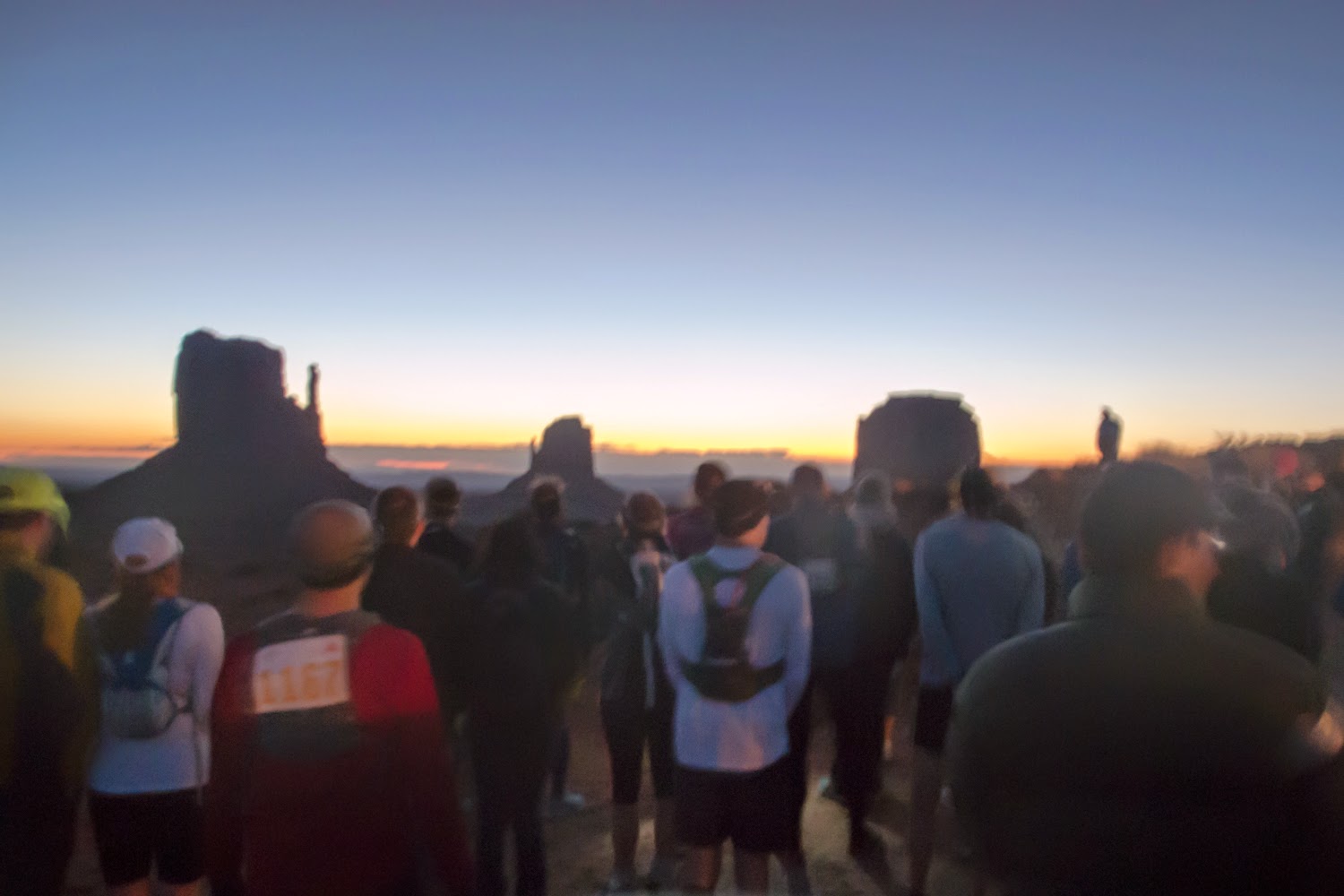 We received a predawn blessing from a representative of the Navajo Nation. Then we lined up, and, in a relatively unceremonious way, we were
off. Dawn broke after a few miles, and the views were
amazing. Most other runners seemed to
have cameras, and photo stops were the rule, not the exception. The terrain was more undulating and sandy
than expected. After the first couple
miles, I revised my expected finishing time estimate from the 10-11 hour range
up to about 12 hours. The segments that
were around mesas had more solid footing, and a moderate amount of
rock-hopping. But the terrain was like
all other conditions, just something to accept and work with.
We received a predawn blessing from a representative of the Navajo Nation. Then we lined up, and, in a relatively unceremonious way, we were
off. Dawn broke after a few miles, and the views were
amazing. Most other runners seemed to
have cameras, and photo stops were the rule, not the exception. The terrain was more undulating and sandy
than expected. After the first couple
miles, I revised my expected finishing time estimate from the 10-11 hour range
up to about 12 hours. The segments that
were around mesas had more solid footing, and a moderate amount of
rock-hopping. But the terrain was like
all other conditions, just something to accept and work with. |
| Across the Utah line, running towards the Brigham's Tomb aid station. |
 |
| Looking South at the Valley from across the Utah State Line |
One mental strategy for a race of this duration might be to
break it down and not think of the entirety of it, but I kept reminding myself
of the race length in order to subdue my urge to pursue other runners or push a
faster pace. Mostly, this worked. Around Mile 14, it no longer helped, as the
weight of the race landed on me. It
helped to treat this as another opportunity to pay attention to what I was
doing in the moment, and to detach myself from my thoughts and feelings, and
just observe:
Wow, so I don’t feel
like running, certainly not for another thirty-six miles. Okay, so noted. Keep the feet moving, and keep sucking down
the nutrition, and it will change. And
then it will change again. And again...
 |
| The "mark" of a true ultra runner. |
About this time, I saw a 100 mile runner walking in the
other direction, 26 hours and 85 miles into his race. By the despair etched on his face, it looked
as if he was struggling mightily, and when I offered some encouraging words, he
brightened like I’d handed him a winning Powerball ticket. It turns out there was an abundance of
encouragement flowing in all directions, and some positive words helped to lift
me out of my own funk in short order.
Some of this can be found at times in triathlon, but the sense of
support and community at this race was truly inspiring. Everyone was cheering for everyone else, even the frontrunners.
After the first 22 mile loop, the rest of the race involved
three loops starting from and ending at the Hogan Aid Station, which became a
sort of temporary community between scenic adventure jaunts. At my second stop here at mile 27, I decided
to give myself a head-to-toe, “full service” aid stop. A volunteer at the aid station helped me out, noting that I had what appeared to be "Ultra Brain." Putting together a plan—like taking shoes and socks off—and
executing it felt like an impossibly complicated task. A fair amount of red sand had snuck in past
the gaiters, and I had one blister. So I dusted off my feet, drained the blister, and switched to the "cover all" Raid Light gaiters. I was at the
aid station for what seemed like half an hour, but it turns out it was
only ten minutes.
I also tried something I hadn’t done on long runs, or in
triathlons: Solid food. At 50 mile pace,
I managed to tolerate pretzels, potato chips, and a Clif Bar, and to suck down
an entire 20 oz. bottle of Tailwind at once on more than one occasion. As long as I kept the pace reasonable, it
worked. I maintained a steady state of fluid, electrolytes, nutrition, and pacing for most of the race.
 |
| The "Totem Pole" and friends |
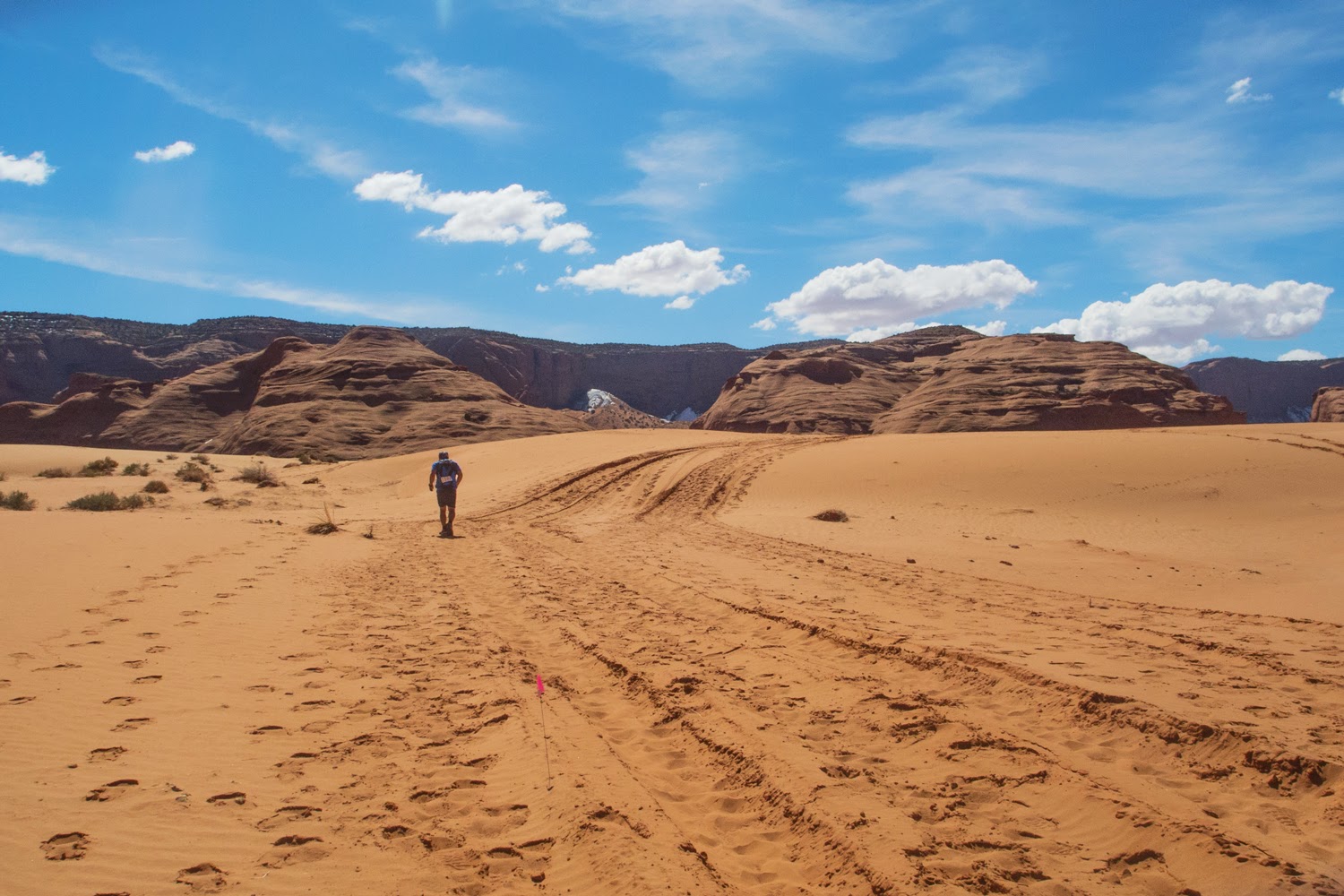 |
| A runner trudges through the sand on the scenic southern loop |
 |
| "Ear of The Wind," at the southernmost point of the course. |
 |
| Mile 41.5, final turnaround on top of the Butte |
The last 7 miles were about how to manage the progressive
muscle failure. First, I power walked,
with a little bit of kick on the downhills.
This stride felt about as graceful as doing a Frankenstein impression on
cross-country skis, but it was fastest, and I was all about the finish line at
this point. My power walking speed was
initially not much slower than my dwindling running speed, but even that
eventually collapsed to a walk up the long final hill to the finish line, 11 hours and 42 minutes after the start.
Two fellow racers almost caught me right at the line, but
somehow I found just that little bit of reserve to stay ahead. The utter failure of leg muscles was beyond
even that of an Ironman by quite a bit. Shivering and limping, with spasming hip flexors, I barely made it to the car,
where I cranked up the heat and began convalescence. It occurred to me to take a final picture of the view before I left, but the body was no longer capable.
 |
| Looking North from the top of Mitchell Butte |
The race was amazing, not just in terms of the course. The aid stations were excellent; the feeling
of community among the racers was like nothing I’d experienced. I’ll definitely do another one, and probably one that Matt Gunn put together.
Just not next weekend.
Monday, November 17, 2014
Quick and Dirty IMAZ '14 Race Report
My first IM DNF, and hopefully my last. Overall, I was surprised to even be racing, as a calf pull 5 weeks ago and a bike crash onto my surgical hip 4 weeks ago had me unable to run, or even walk, without limping as recently as 2 weeks ago. As with so many things, I have my wife Karen to thank for strongly suggesting that I get some physical therapy instead of being my typical terrible patient self and trying to push through, as this was going nowhere. Melissa from Peak Action PT, and John Woolf and the gang at ProActive did an amazing job to get me on my feet in an unfathomably short time, just as I was convinced that it was time to hang it up for the rest of the year.
So, the race, by discipline:
Swim: 1:00:38. 4th in age group. Good enough.
Relatively low contact with other swimmers, which was aided by swimming
fast out of the gate for the first 100 or so arm cycles. Starting out at a moderate pace last year led to being
swamped by a pack, so I figured it was going to involve some flailing one way
or another. My swim seems to get a
minute slower per year, probably as my build trends away from that of a lifter/ex-boxer/martial artist to that of a triathlete. And if I may whine for a second: For all the time I spent in the pool as a
kid, I’m surprised this is all I have to show for it in triathlon swim terms. But distance freestyle was my second worst
event… Whatever. An Ironman is a marathon with
an inordinately and hazardously long warmup, with the swim being
the part where you warm up all the wrong muscles first.
T1: 3:45. Decent, given how long we had to run to get through it.
Bike: 4:56:11. 2nd in age group off the
bike. Right where I'd need to be to have a shot at Kona. Pacing was solid, if not just slightly
overcooked. 15-20 mph headwinds going up
the grade on laps 2-3 made things slower, and turned my strategy from “flat course” to “hilly
course”: slightly more wattage on uphills; slightly less on downhills. For fellow numbers geeks, Overall NP was 235W, IF
0.72. Most of that was on laps 1-2.5,
where NP was 240W, and AP was 236. The wind was so strong
on the way back to T2 that I pretty much coasted the last half lap. Power was on the higher end of the recommended range,
but what might have been excessive was my propensity to push harder into the
wind, and to push harder on the first half of lap three just so I could be done
pedaling into the wind sooner. On numerous occasions, I had to yank my own choke chain and slow down. I felt badly for the folks I passed who were only on their second lap, and would have to come back into the wind a third time. The whole way, I seemed to be behind in hydration,
and gulped down water as much as possible.
Unfortunately, I also gulped down air, which led to a bloated
abdomen that was probably most of my demise on the run.
T2: 1:55. It could've been a few seconds faster, but I think I was savoring not pedaling any more.
Run: 20.4 miles in
3:23. Five weeks of injuries
made me start the run with a “let’s see how far I can go” mindset, as opposed
to a “finish at all costs” mentality, even though the calf and hip gave me zero
problems. My guts were bloated and
churning from the get-go, which was frustrating, because I’ve been working on
this historical problem for a couple years.
A porta-potty stop at mile 5 helped some, but it never really got better. Some of it might have been bike pacing, but some was definitely bloat from swallowing air.
Negative self-talk was incessant, and I worked on myself to get through every mile and not quit. I kept going because I was still managing to push out some good miles, and managing to process water and IM Perform
without it backing up in my stomach too much.
At about mile 13, the fade kicked in. I pushed through to mile 17, past the
spot where the family was waiting to cheer me on (thanks, gang!!!). Karen told me I was still in contention, but
my body was telling me otherwise. At this point, I decided I would push through to the finish barring complete collapse. I ran
another mile and switched to “rescue” mode: walk the aid stations, drink 2
waters and 2 cokes at each, run between them as much as possible. The coke was not de-fizzed as it usually is,
which led to some really vile projectile belching that would have been pretty
funny to watch if I hadn’t been the one doing it. So I switched back to IM perform and
water.
About a mile later, I had to walk between aid stations. My body temp started dropping: when I reflexively
poured water on my head at the next aid station, I actually felt cold. At the mile 20 aid station, I stopped at the
porta-potty to deal with bloating and nausea.
By the time I was done, I was wet, shivering, and feeling no better in GI
terms. There was no reason to think this
was going to go in the right direction before I got seriously hypothermic, so I
hung it up. Medics checked me out; aid
station volunteers kept me in the warm clothing, IM Perform, and potato chips
(thanks!!!), and I eventually got a golf cart ride halfway to transition. The ride was a
whole series of misadventures, but that’s another story…
In spite of the occasional self-recriminations for not
finishing, I'm overall pleased with this race. This was a solid step in the direction of
qualifying for Kona. My strategy out of the gate was not
to pace it evenly (and slowly given recent injuries) in order to finish, but to do what I needed to be in World Championship contention for as long as I could. And I
was in the hunt for most of the race, and would’ve been right in it to the
finish line were it not for aforementioned issues. I think the dietary contribution to bloating has been successfully eliminated. It seems that all that separates me from
Kona/podium is a little more run endurance, and just not swallowing so much
air. This doesn’t sound insurmountable,
which is what it seemed like as recently as this past Saturday.
Despite the result, I’m much more confident that I’m capable of pulling
off Kona sooner rather than later.
...And now, it’s ski season.
Bring on the snow!!
Saturday, August 16, 2014
Blowin' In The Wind (Tunnel...)
Pictures speak volumes, so I'll keep the comments minimal. I had a wind tunnel fit with Aaron Ross at Faster in Scottsdale. Compare the old position (also visible on top of this blog) to the new. Definitely $$$ well spent.
 |
| Original position, wearing the 3D reference points |
 |
| Computer modeling of old position. Max knee angle a tight 132 degrees--far from optimal. So much for DIY fitting... |
 |
| New position, flatter back, head below the line of the back, knee angle approaching 150 degrees. Not quite Sebastian Kienle, but closer. |
 |
| In the wind tunnel, trialing a shorter tailed helmet and a new kit. Long-tailed helmet was worse. Getting blasted in the face with quick-moving air was exhilarating! |
 |
| The "final answer," my original helmet plus a new, snug Castelli kit, aerobars up to 15 degrees. 2750 grams of drag. Per Aaron, this is "definitely competitive for someone my size," and almost 300 less than even the new position started in the wind tunnel. Likely to be notably less with a Zipp 808 up front and a disc wheel in back! |
Thursday, July 3, 2014
Race Report: Touch Alcatraz And Go!!
Our Low-Altitude, Low Temperature training camp this month, at the In-Laws' house in Marin County, CA put us right next to the San Francisco Bay. An open water swim or two was definitely part of the plan, but Karen found an organized swim from San Francisco's Aquatic Park to Alcatraz and back, which was just too cool for me to resist:
http://waterworldswim.com/swims-events/touch-alcatraz-n-go/
 Between the movie Escape From Alcatraz and the triathlon of the same name, I've always found this swim to be particularly enticing, yet intimidating, with famously cold water and currents created by the tide washing in and out of the Bay under the nearby Golden Gate bridge. I was asked about sharks, but for whatever reason, I'm not worried about them.
A quick trip over the Golden Gate bridge early on Saturday got me to the SF Aquatic Park. We congregated and discussed the race--from the Aquatic Park to Alcatraz and back, 2.5 miles, right at high tide to minimize the Bay's famous currents.
People introduced themselves, and finished with two numbers. One said, "26 and 27." Another, "40 and 41." Split times? I wondered. No, someone explained, total Alcatraz crossings.
After a prayer led by the coach, we lined up. I splashed water on my face. Cold, but at 60 degrees, no worse than Lake Coeur D'Alene in June of 2012. Then we were off. A few strokes, a goggle adjustment, a few more strokes, and I was in the game. No more fear of finishing, freezing, feeding the sharks. There were numerous support kayakers in the water, and there was always at least one nearby. Sighting out to Alcatraz and the boat was easy. The boat that we touched, sitting parallel to Alcatraz, came up quickly, probably with a current assist. The slower pace of the way back confirmed this. Ghirardelli Square seemed to remain in place no matter how many times I looked up.
A misjudgement in sighting references left me a couple hundred yards East of the mouth of Aquatic Park, so I got a little extra racing for my money. Finally, I paddled into the finish 2.5+ miles later, 1 hour, 6 minutes, and 55 seconds later, in 4th place:
The official video: https://www.youtube.com/watch?v=4ClusQC_ZEs
This was a very well-run, enjoyable, safe experience. I'd recommend it for anyone who thinks they can do the distance. $260 wasn't cheap, but neither is renting a big boat, or appropriate kayak support for a field limited to 20 people. I'd definitely do another.
http://waterworldswim.com/swims-events/touch-alcatraz-n-go/
A quick trip over the Golden Gate bridge early on Saturday got me to the SF Aquatic Park. We congregated and discussed the race--from the Aquatic Park to Alcatraz and back, 2.5 miles, right at high tide to minimize the Bay's famous currents.
 |
| 1.25 miles to the Rock! |
People introduced themselves, and finished with two numbers. One said, "26 and 27." Another, "40 and 41." Split times? I wondered. No, someone explained, total Alcatraz crossings.
After a prayer led by the coach, we lined up. I splashed water on my face. Cold, but at 60 degrees, no worse than Lake Coeur D'Alene in June of 2012. Then we were off. A few strokes, a goggle adjustment, a few more strokes, and I was in the game. No more fear of finishing, freezing, feeding the sharks. There were numerous support kayakers in the water, and there was always at least one nearby. Sighting out to Alcatraz and the boat was easy. The boat that we touched, sitting parallel to Alcatraz, came up quickly, probably with a current assist. The slower pace of the way back confirmed this. Ghirardelli Square seemed to remain in place no matter how many times I looked up.
A misjudgement in sighting references left me a couple hundred yards East of the mouth of Aquatic Park, so I got a little extra racing for my money. Finally, I paddled into the finish 2.5+ miles later, 1 hour, 6 minutes, and 55 seconds later, in 4th place:
 |
 |
| Greeting a fellow traveler afterwards |
This was a very well-run, enjoyable, safe experience. I'd recommend it for anyone who thinks they can do the distance. $260 wasn't cheap, but neither is renting a big boat, or appropriate kayak support for a field limited to 20 people. I'd definitely do another.
Saturday, May 3, 2014
Whiskey Offroad 50 Miler
This is a popular local ride that attracts world-class talent on the high end. Karen's growing enthusiasm for MTB got us excited enough enough to sign up, and given my proclivities, I opted for the longer distance/better workout. This was definitely a C to C- race for me, but the length fo the race inspired Coach Bill Daniell to throw in some specific training for it. 50 miles on a MTB is not a trivial undertaking. I'd logged 45 miles in 4 hours at local MTB spot "Fantasy Island," done a 4 hour ride at the more technical Star Pass area to see if I could still negotiate obstacles when my brain started turning to mush, and otherwise felt pretty good about all around fitness.
We pulled into Prescott's historic downtown area the previous night, and all appeared well. But weather.com was less optimistic:

Having done my only other MTB race in the rain, and having gone backcountry/x-country skiing and snowshoeing many times, I knew the weather would be manageable with the proper gear. In this case, that was smartwool and bike shorts under a rainproof jacket and pants, with shoe covers over Hokas (platform pedals without cleats, for now. . .), backcountry ski gloves, and with extra layers for top, bottom, and head in the backpack. Nutrition was 100 oz. of IM perform with a couple extra scoops of maltodextrin and baking soda to neutralize the acid, plus enough to make another refill, about 350 calories/hour. This concoction has made my twitchy, reflux-prone tummy much happier than just Perform by itself. I had a Clif Bar in case I needed it, but planned to go liquid only, as with Ironman.
We self-seeded at the start line according to posted categories. The "Nervous, but I got this" category spoke to me. The "Faster than Most of My Friends" category spoke to me as well, but not so kindly. . . I appeared to be one of the few fully geared up at the starting line, which made me wonder if I'd overdone it. Many had just lycra tops and bottoms, some with a garbage bag on top. This was probably pretty appropriate for what the weather was at that moment: 40-ish degrees and drizzling.
The rifle shot sounded, and we were off, climbing out of the city on the Tarmac for 5 miles. "Possible Wintry Mix" for weather turned out to be far more "wintry" than mix. Pretty much as soon as we got on the trail, it went from drizzling to snowing to hailing like crazy. 1-2" accumulated; the Garmin showed temps right around 28-30F for the first half of the race, and winds up on top of the mountain were steady at 20 mph with 30-50 mph gusts. I got wet eventually, but at some point it occurred to me that being wet itself wasn't making me cold, as the wind wasn't getting through, and water wasn't running freely over my skin. Go figure that a tri geek would get the clothing piece right. . .but I am a winter sports geek too. Initially, the riders in front carved a muddy track in the accumulated hail, but after awhile, it just stayed frozen. As with my first race, these were new conditions for me: On the job training.
The only thing that made me contemplate DNFing was serious face pain from the wind/cold, and getting pelted by horizontal hail from above, and flung-up mud from below. I'd prepared for hypothermia, but not so much frostbite. There were some seriously hypothermic peeps out there. One dude was sitting next to his bike alongside the trail, vacantly staring at his hands, clearly out of it. A few of us made sure that he got back to the aid station. As I reached the turnoff to the spur for the 50 mile race, the decision on how to proceed loomed. Turning right would mean only completing the 25 mile course; turning left meant riding down, then back up the big hill and doing the whole 50 mile course; and then there was the aid station, where many riders were eating, drinking, warming up in a tent, and generally getting more comfortable.

I did a quick survey: muddy, wet from head to toe, but warm enough, hydrated enough, well loaded up on sugary salt water. No real reason to stop. Ignoring the siren song of a shorter course or the comfortable aid station, I turned straight down the spur. Riding downhill made the hail pelt my face even faster, and the mud fly up in greater quantity. But after a couple of miles, we made it to the other side of the storm cell, and the course actually got fun. The aid station at the end of the spur was a little slice of heaven. I got an improvised chain cleaning and lube with motor oil, a few pretzels, and, unfortunately, a Camelbak refill of Roctane, which I'd never used. My mildly impaired fingers spilled the refill of my personal concoction all over the ground. . .

Climbing back up the hill was, unsurprisingly, a great workout. Those of us riding up banded together and talked to pass the time. The last 12 miles of the course was back to singletrack. I took it a little slower than normal, as I felt pretty tired, and didn't quite trust my judgment on obstacles. Finishing was heavenly. Lunch was even more so.
Karen was going to do the 25 mile race, which started later, but it kept getting delayed, and shortened, so she bagged it and opted for a trail ride today. I think also she was worried re me given the conditions. Sweet, but I'm also a preparedness geek.
I finished in 6 hrs and 3 minutes, 256th out of 348 finishers and about 700 starters, 52/72 in the M45+ "Masters'" finishers: Definitely not DFL, like my first MTB race!! There were 43% Fewer finishers than last year, so I'd guess a DNF rate of at least 50%.
I'd definitely do this race again. Even with similar weather.
We pulled into Prescott's historic downtown area the previous night, and all appeared well. But weather.com was less optimistic:
Having done my only other MTB race in the rain, and having gone backcountry/x-country skiing and snowshoeing many times, I knew the weather would be manageable with the proper gear. In this case, that was smartwool and bike shorts under a rainproof jacket and pants, with shoe covers over Hokas (platform pedals without cleats, for now. . .), backcountry ski gloves, and with extra layers for top, bottom, and head in the backpack. Nutrition was 100 oz. of IM perform with a couple extra scoops of maltodextrin and baking soda to neutralize the acid, plus enough to make another refill, about 350 calories/hour. This concoction has made my twitchy, reflux-prone tummy much happier than just Perform by itself. I had a Clif Bar in case I needed it, but planned to go liquid only, as with Ironman.
We self-seeded at the start line according to posted categories. The "Nervous, but I got this" category spoke to me. The "Faster than Most of My Friends" category spoke to me as well, but not so kindly. . . I appeared to be one of the few fully geared up at the starting line, which made me wonder if I'd overdone it. Many had just lycra tops and bottoms, some with a garbage bag on top. This was probably pretty appropriate for what the weather was at that moment: 40-ish degrees and drizzling.
The rifle shot sounded, and we were off, climbing out of the city on the Tarmac for 5 miles. "Possible Wintry Mix" for weather turned out to be far more "wintry" than mix. Pretty much as soon as we got on the trail, it went from drizzling to snowing to hailing like crazy. 1-2" accumulated; the Garmin showed temps right around 28-30F for the first half of the race, and winds up on top of the mountain were steady at 20 mph with 30-50 mph gusts. I got wet eventually, but at some point it occurred to me that being wet itself wasn't making me cold, as the wind wasn't getting through, and water wasn't running freely over my skin. Go figure that a tri geek would get the clothing piece right. . .but I am a winter sports geek too. Initially, the riders in front carved a muddy track in the accumulated hail, but after awhile, it just stayed frozen. As with my first race, these were new conditions for me: On the job training.
 |
| "Interesting" conditions! |
The only thing that made me contemplate DNFing was serious face pain from the wind/cold, and getting pelted by horizontal hail from above, and flung-up mud from below. I'd prepared for hypothermia, but not so much frostbite. There were some seriously hypothermic peeps out there. One dude was sitting next to his bike alongside the trail, vacantly staring at his hands, clearly out of it. A few of us made sure that he got back to the aid station. As I reached the turnoff to the spur for the 50 mile race, the decision on how to proceed loomed. Turning right would mean only completing the 25 mile course; turning left meant riding down, then back up the big hill and doing the whole 50 mile course; and then there was the aid station, where many riders were eating, drinking, warming up in a tent, and generally getting more comfortable.
I did a quick survey: muddy, wet from head to toe, but warm enough, hydrated enough, well loaded up on sugary salt water. No real reason to stop. Ignoring the siren song of a shorter course or the comfortable aid station, I turned straight down the spur. Riding downhill made the hail pelt my face even faster, and the mud fly up in greater quantity. But after a couple of miles, we made it to the other side of the storm cell, and the course actually got fun. The aid station at the end of the spur was a little slice of heaven. I got an improvised chain cleaning and lube with motor oil, a few pretzels, and, unfortunately, a Camelbak refill of Roctane, which I'd never used. My mildly impaired fingers spilled the refill of my personal concoction all over the ground. . .
 |
| I guess it's not a "Belfie" if my wife took it. . . But it is most definitely a dirty pic. |
Karen was going to do the 25 mile race, which started later, but it kept getting delayed, and shortened, so she bagged it and opted for a trail ride today. I think also she was worried re me given the conditions. Sweet, but I'm also a preparedness geek.
I finished in 6 hrs and 3 minutes, 256th out of 348 finishers and about 700 starters, 52/72 in the M45+ "Masters'" finishers: Definitely not DFL, like my first MTB race!! There were 43% Fewer finishers than last year, so I'd guess a DNF rate of at least 50%.
I'd definitely do this race again. Even with similar weather.
Tuesday, April 22, 2014
Bear Canyon Trail Run Photos
2+ hr trail run up Bear Cyn nearby. Steep and rocky.
Garmin called it 1768 ft elevation gain over 6 mi (then down). Probably
2/3 running, 1/3 "Relentless Forward Progress," like the book.
 |
| The view. Switchbacks up from the wash on the left side. |
 |
| Backlit Saguaros and Ocotillo blooms (orange) |
Tuesday, January 14, 2014
Quintana Roo Bike Feature
My bike was featured by Q-Roo!!:
http://quintanarootri.blogspot.com/2014/01/tom-quigley-and-his-qr-illicito.html
http://quintanarootri.blogspot.com/2014/01/tom-quigley-and-his-qr-illicito.html
Monday, December 23, 2013
Post-Booger and Food Poisoning Running Extravaganza
The gang is skiing up in
Flagstaff, so I'm doing the flexible bachelor schedule thing for
48 hours, meaning, when it's still fun. I had a nice run: home to top
of Sabino Cyn and back after work, 14.6 mi with 2,000-ish feet of
elevation gain, in just a little over 2hr. Like many first runs/rides
back from idleness, it felt like a bit of an exorcism.
Friday, December 6, 2013
IMAZ 2013 RR: Sub-10 and Tenth in M45-49!!

10/292 in M45-49, 144/2700-ish overall. Yep, that's the punch line, and a happy one!
But
first things first. The race itself: If you're reading this not
because you have an abiding interest in relatively benign endurance sports-based midlife crises, but because you're considering doing an Ironman, then let me get right to the point: This race is the best, period. It's a pain in the neck to get into the race, but it's worth it. IMAZ
has moderate temperatures, great race support, a flat course, and a hub
airport right nearby. And if you're local, an M-dot branded IM within
driving distance is money in the bank. Unfortunately, so many people
agree with this sentiment. Many sign up almost two years ahead of time
to volunteer a year beforehand instead of paying the $1400-ish dollars
for a foundation spot one year in advance. Try to register 51 weeks
ahead of time, and you just may be out of luck.
There
are a few seasoned endurance athletes who grumble that IMAZ is too
easy, but that's a hollow argument for just about everybody, and a false
dichotomy for most of those who remain. Doing IMAZ doesn't preclude
you from doing Norseman, IM Lake Tahoe, or their ilk. Soak up IMAZ's
flatness, its pleasantness, its SPEED!
Now to the race itself.
Pre-race:
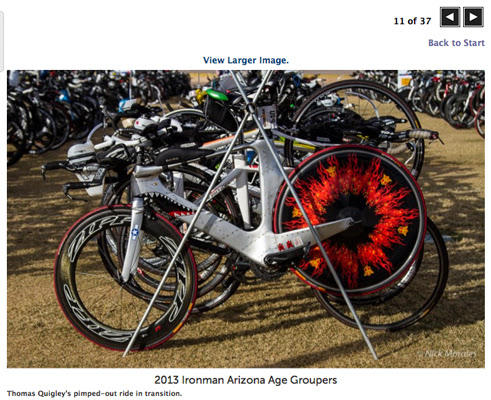 |
| The steed got a little press from: http://triathlon.competitor.com/2013/11/photos/photos-2013-ironman-arizona-age-groupers_90245 |
Unlike
last year, I got my gear and life together several days ahead of time.
I didn't go to work on the morning of the final day of check-in. This
saved much anguish. The only smarter thing I did was not doing the race at the same time as my wife and fellow parent of three children. Some things seem so obvious in hindsight. But not flailing around like a one-legged man in a butt kicking contest clearly left me more rested and energized for the race. A good night's sleep, a bunch of caffeine, and a big bowl of oatmeal also helped.
Swim:
 |
| View of the swim from Karen's Kayak |
The swim remains a mass start from the water, preceded by several minutes of bobbing and shivering. The
goal was to get away from the crowds as quickly as possible, but this didn’t
really happen. Prerace visualizations involved majestically
soaring to the front of the swim pack with long, smooth strokes. Reality more closely resembled a mosh
pit, more so than the previous year. The first twenty minutes
were bumpy, and I had to deliberately reel myself in, calm down, and slow down.
Things spread out more, and I got a good amount of open
water on the second half. I finished in
59:46, not as fast as last year, but under an hour.
T1 was faster than last year, which made up for the slower
swim. I didn’t fool around with
compression socks or any other gimmicky nonsense. Helmet, shoes, stow the wetsuit, go.
 |
| Just a little ride. . . |
I also noticed that I, and some of my competitors, were
picking up “friends,” some of whom kept the required 4 bike length distance,
some of whom didn’t. The
shamelessness of some of the drafting I saw amazed me: one woman who wound up winning her age group
and punching a Kona ticket, stayed less than a bike length behind the rider in
front of her for more than a whole lap.
Another pro did the same. At any rate, lap #2
went down in 1:38. Even though I’d been
keeping a legal distance, my average power dropped 10 watts for the same speed. I mused at the energy
savings the true wheelsuckers were getting.
At the turnaround, I spotted the fam and we exchanged cheers, which was heartening.
At the turnaround, I spotted the fam and we exchanged cheers, which was heartening.
The sense of impending marathon on lap #3 got me
worried. This led to a couple of
decisions—one good, one bad. I eased off
on my pace just a little, which was good, and I sucked down a bunch of
nutrition in the last 10 miles, which turned out not to be so good. I finished in 5:00:38, almost exactly as
planned, and 39 tantalizing seconds away from sub-5 hours.
 |
| T2: Where you realize that wanting to be done with a 112 mile bike ride and wanting to run a marathon are not necessarily the same thing. . . |
T2 involved a little more fumbling than expected. The waistpack/hat bundle that had netted me a
laser-quick transition at the Soma 70.3 triathlon last month seemed somehow less
intuitive, and I got out in 2:28.
 |
| Only 4 miles into it, and still running strong. |
But then I began to slow.
Inability to hydrate or get down calories was catching up with me. By mile 17, I decided to walk the aid stations
so I could drink two waters and cokes at each, in the hope of catching up and
getting re-energized. It helped a
little. The temptation to give up and do
serious walking loomed large. Again, I
hadn’t imagined this much of a struggle this soon. My goals were in peril if not lost. But it there’s one thing medical residency
training has taught me, it’s to carry on as well as possible in less than
perfect circumstances no matter how grim things looked. I set aside my nascent whininess, brought my mind back to technique, and
started a gratitude list in my mind.
Still healthy, still married, still employed, still alive. How bad could any self-inflicted discomfort
really be, relative to the pain and misfortune I get to see patients and
families experience every day at work?
Soon I was a little happier/weepier/punchier, if not faster.
 |
| The rooting section! |
I decided to run through the aid stations at miles 23-25
with minimal hydration. Not enough fluid
might be a problem, but fluid was making me cramp, so I figured it would be
a wash. At mile 25, I finally glanced at
the overall time on my watch, which I’d been avoiding for the whole run. 9:48.
1.2 miles in 12 minutes to get to the finish line under 10 hours! I knew if I pushed
it, I’d make it. I also knew it would really hurt: I’d kept my pace just below
the cramping/nauseous threshold, and this was a deliberate venture into that
realm. Hopefully it wouldn’t
backfire.
But I told myself, Temporary suffering’s
got nothing on knowing I could’ve gone sub-10 and didn’t give it my all. . .
I cranked it in pretty hard.
At mile 26, a spectator said that I had three minutes to finish under 10
hours. I didn’t look at the watch, as I
was going as hard as I could, and feeling it.
Coming up towards the chute, my buddy Vince greeted me with a fusillade
of shutter clicks and a smile. I did my
best impression of a smile in return.
Turning into the chute, I saw the clock at the finish, mere yards away:
9:58:34. I was going to make it under
10! As much as it hurt, I ran hard through the finish. 9:58:59!!
I was elated.
 |
| Warming up in Medical |
To take stock briefly: PR by 40 minutes, 30 minutes faster
on the run, right on pace for the bike, a hair slower on the swim. Nutrition was better, but still in need of
significant improvement. Antacids, more
nutrition on the bike, less nutrition on the bike. . .it’s not clear to me what’s
best. But the good news is that there’s
some chance that I may not have to wait to turn 50 to contemplate a serious run
at a Kona slot. . .tune in next year.
Battle scars, or something like that:
 |
| Beat up feet |
 |
| Wetsuit abrasion |
 |
| Probably got banged during the swim. And not a very manly looking bruise at that. |
In closing, I want to thank my wife and our kids for putting
up with this nuttiness. It’s easy to see
in retrospect what I asked everyone to give up for a few months, but harder in
the moment. Thanks also to
those who helped me get back from a hip fracture 357 days before this race to
where I am today: My Orthopedic colleague Dr. Jordan Smith, who fixed it, Dr. Pat Boyle,
who too care of me, John Woolf at ProActiv Physical Therapy for getting me
going, Melissa Hollmann at Peak Action Physical Therapy for getting the hip
loose enough to really perform, Charlie Roach Chinese Medicine for getting the energy flowing
again, Brian Grasky for extensive help with running form, Vince and the gang
for the online support and numerous laughs, and coach Bill Daniell for designing
a plan that did an excellent job of making the most of limited time.
Subscribe to:
Posts (Atom)